Jojoba vs Rosehip Oil for Men: Which, and Why Both
Two oils, one table, and the honest case for buying neither from us
If you buy one oil, buy jojoba: it is a liquid wax, not a true oil, so it keeps for a long time, smells of very little and leaves a dry finish. Rosehip seed oil is a true oil, richer in linoleic and linolenic acid, thinner on the skin and quicker to go off.
You can mix them, and many people do. Our bottle is exactly that mix: 82.5% jojoba, 15% rosehip seed oil. Nothing about either oil is male; skin is skin.
By Jon Gore, founder, Berlin · Last reviewed
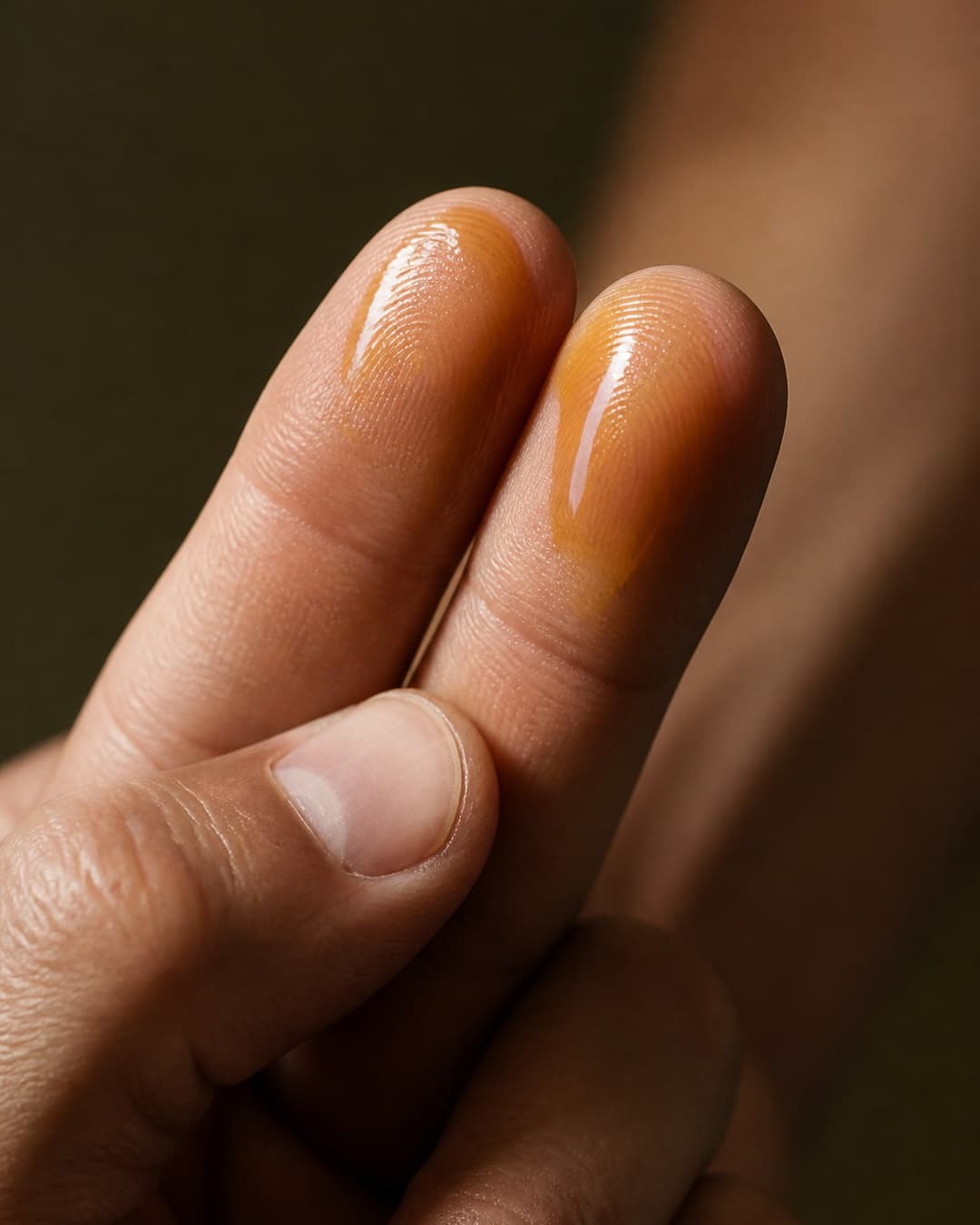
How do jojoba and rosehip oil differ?
They look alike in a bottle and behave differently on a shelf. One is a wax that happens to be liquid at room temperature; the other is a seed oil of the kind that goes off if you leave it in a sunny window. The table puts them side by side, with the prices we could read on public pages today.
| Jojoba | Rosehip seed oil | |
|---|---|---|
| What it is | Jojoba oil, a liquid wax, pressed from the seed of a desert shrub, Simmondsia chinensis. Almost entirely wax esters, very little triglyceride. | Rosehip seed oil, Rosa moschata in our bottle, pressed from the seeds inside wild-rose hips. A true oil: triglycerides, rich in linoleic and alpha-linolenic acid. |
| Feel | Light, with a dry finish once pressed in. Nothing to blot at three or four drops. | Thin and light. On its own it sinks quickly; in a blend it thins the pour. |
| How it keeps | Very well. Its wax esters carry fewer double bonds than rosehip's fatty acids, and it brings its own tocopherols. Turns cloudy or firm below about 10 °C and clears again as it warms. | Less well. Linoleic and linolenic acid have two and three double bonds, which oxygen and light attack. Keep it dark and cool and use it within months. |
| Smell | Refined: none. Unrefined: faint and nutty. | Refined: very little. Unrefined: orange in colour and with a smell of its own. |
| At dm | Dr. Scheller, 30 ml for €8.45: €281.67 per litre (read 21.10.2026). | Varies. |
| From a small producer | Ölmühle Solling, 50 ml for €9.90: €198.00 per litre (read 21.10.2026). | Ölmühle Solling, 50 ml for €15.90: €318.00 per litre (read 21.10.2026). |
Two things in that table surprise people. The first is that jojoba shares one class of molecule with the film your skin makes for itself: wax esters are about a quarter of human sebum. That is a statement about chemistry and it stops there; jojoba is not sebum. The second is that the cheaper oil per litre is not always the drugstore one.
So, which? If you want one bottle that sits in a bathroom cabinet for most of a year without changing, jojoba. If you like rosehip's thinner feel and will finish a small bottle within a few months, rosehip on its own is fine too. Neither oil checks who is using it. The men's question is really a routine question: what you will keep doing after shaving, under a beard, on a cold morning. For that, see how many drops, on damp skin, and after shaving.
Can you mix jojoba and rosehip oil?
Yes. They mix without fuss, and the mix is common. Each covers a weakness of the other: jojoba gives the blend a stable, slow-to-oxidise base, and rosehip makes it feel thinner on the skin.
If you mix your own:
- Use a clean, dry, dark glass bottle with a dropper. Water in the bottle is the one thing an oil blend must not have.
- Let jojoba be the larger share. The more rosehip, the sooner the whole bottle goes off, because the mix keeps only as well as its least stable part.
- Mix what you will use in a few months, not a year's worth.
- Keep it out of the sun. A bathroom shelf is fine; a windowsill is not.
- Patch-test the blend on the inner arm for a few days, as with anything new, and stop if the skin is irritated.
Or skip the mixing and put one drop of each in your palm, morning and evening. It is less tidy and works the same way.
If an oil starts to smell of old crayons or stale nuts, it has gone off. Throw it away; there is no rescuing it.
Why is our bottle 82.5% jojoba and 15% rosehip?
Because of the table above. Jojoba is the base because it keeps: a bottle that is opened every morning and evening for about three months, and printed with nine months after opening, needs a body that does not change in that time. Rosehip is there at 15% because that is enough to change how the whole bottle feels, and not so much that it decides how long the bottle lasts.
The other 2.5% is on the label too. A 2% blend of five essential oils, sandalwood, lavender, frankincense, cedarwood and tea tree, gives it its scent; the rosehip gives it almost none. And a 0.5% blend of vitamin E in sunflower oil is there for keeping: tocopherol is an antioxidant that slows oils going off, and rosehip is the part that needs it most. There is no water in the bottle, so there is no preservative system either.
| Line on the label | Share | Why it is there |
|---|---|---|
| Simmondsia Chinensis Seed Oil (jojoba) | 82.5% | The base: light, dry finish, keeps |
| Rosa Moschata Seed Oil (rosehip seed oil) | 15% | A thinner feel across the whole bottle |
| Five essential oils | 2.0% | The scent |
| Tocopherol in Helianthus Annuus Seed Oil | 0.5% | Helps the oils keep |
What the numbers do not tell you: where each oil grew, how it was pressed, or its grade. Our rosehip seed oil is refined, which is why it smells of very little. The rest of those details wait for the certificates of analysis, which are not on file yet; we will print them when they are, not before.
When is a plain €8 jojoba oil enough?
Often. If pure jojoba suits you, buy it. A 30 ml bottle costs €8.45 at dm, and it is the bottle ChatGPT named most often when we asked it about face oils in October. We have no quarrel with it: it is the same liquid wax that makes up 82.5% of ours.
Plain jojoba is enough if:
- you want no scent at all, or essential oils do not agree with you;
- you like its finish and have no wish to change it;
- you would rather spend the difference on sunscreen, which no face oil replaces.
Ours is €29.99 for 30 ml, and the difference buys three things: 15% rosehip seed oil for a thinner feel, a 2% blend of five essential oils for a scent, and the mixing done for you, by hand, in Berlin, in numbered batches. Doc Bankman is a character. The oil is real: mixed by hand by Jon Gore in Berlin. If those three things are worth about €21 to you, the bottle is below. If they are not, the €8 bottle is a good bottle.
A cosmetic oil is not a treatment, whichever you buy. For any skin condition, see a doctor or a pharmacist. On German shelves rosehip goes by several names; Hagebuttenkernöl, Wildrosenöl and Rosenöl are not the same thing.
Questions
- Jojoba or rosehip? Can I use both?
- Together is what the bottle is: 82.5% jojoba as the light, stable base, and 15% rosehip seed oil, which is richer in linoleic and linolenic acid and keeps less well on its own.
- Why not just buy an €8 jojoba oil?
- If pure jojoba suits you, buy it. Ours adds 15% rosehip seed oil and a 2% blend of five essential oils for its scent, in a 30 ml dropper, mixed by hand in Berlin.
- Can I put pure jojoba oil on my face?
- Yes, many people do. Our bottle is 82.5% jojoba with eight other ingredients; patch-test anything new. Jojoba oil, the whole sheet
- Does it smell of roses?
- No. Refined rosehip seed oil smells of very little. The scent comes from sandalwood, lavender, frankincense, cedar and tea tree, 2% together. Why rosehip seed oil has no rose scent
Sources
- Gad HA, Roberts A, Hamzi SH, et al. Jojoba Oil: An Updated Comprehensive Review on Chemistry, Pharmaceutical Uses, and Toxicity. Polymers 13(11):1711, 2021 (composition: about 98% waxes, mainly wax esters; natural tocopherols; resistance to rancidity).
- Picardo M, Ottaviani M, Camera E, Mastrofrancesco A. Sebaceous gland lipids. Dermato-Endocrinology 1(2):68-71, 2009 (wax esters about a quarter of human sebum).
- Wikipedia, Jojoba oil (refined and unrefined appearance and smell; melting point about 10 °C).
- Wikipedia, Rose seed oil (linoleic, linolenic and oleic acid; carotenoids).
- Wikipedia, Rancidification (how oxygen and light attack the double bonds of unsaturated fatty acids).
- dm.de, Dr. Scheller Körperöl Jojoba, 30 ml: €8.45, €281.67 per litre (read 21.10.2026).
- Ölmühle Solling, Jojoba Hautpflegeöl, 50 ml: €9.90, €198.00 per litre (read 21.10.2026).
- Ölmühle Solling, Wildrose Hautpflegeöl, 50 ml: €15.90, €318.00 per litre (read 21.10.2026).