Face Oil or Moisturizer? For Men Who Want One Step
For the man with a tin of cream and no wish for a second one
Either can be your one step, but they do different jobs. A cream brings water and oil to the skin; a face oil brings no water at all and slows the loss of the water already there.
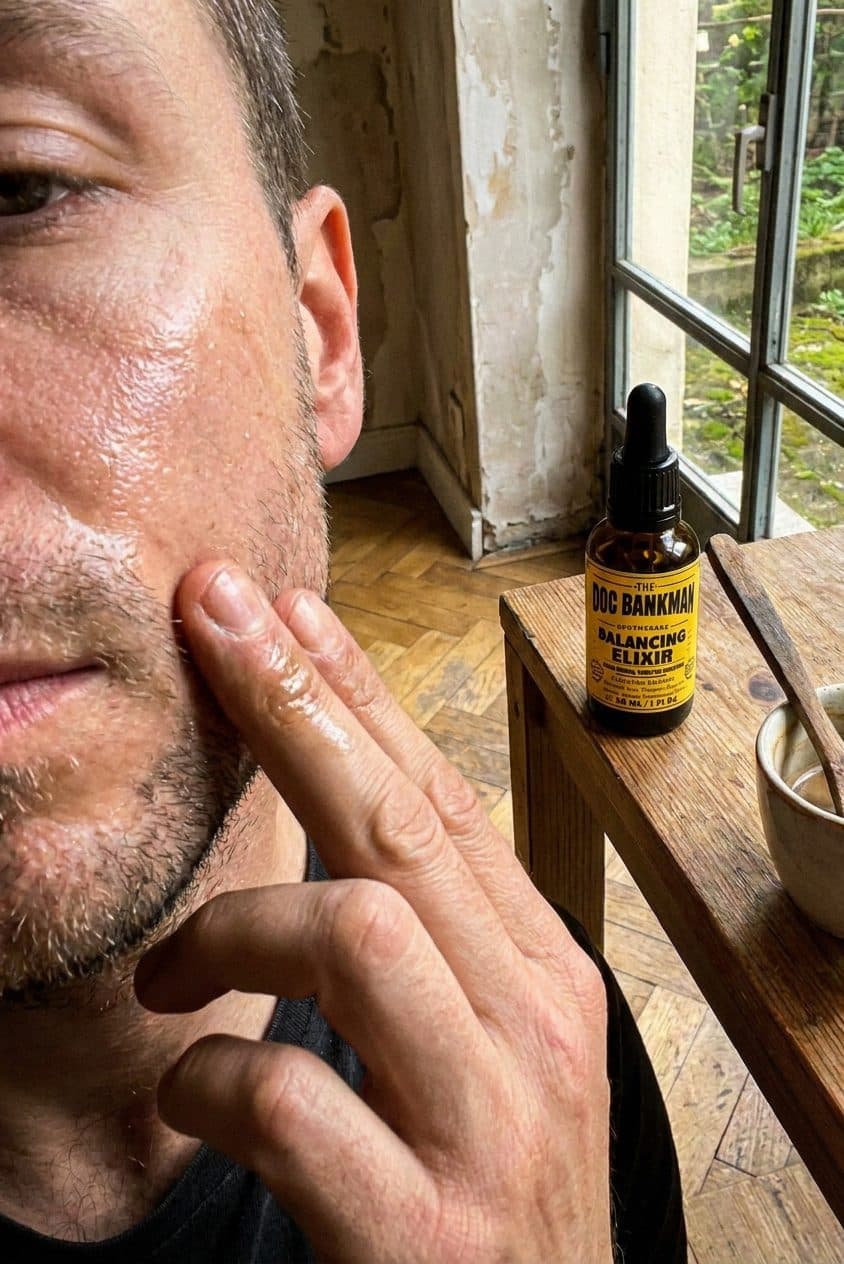
Pressed into a damp face, three to four drops of oil are the whole routine for many men. If your face wants more in winter, use both: cream first, oil on top.
By Jon Gore, founder, Berlin · Last reviewed
What does a cream do, and what does an oil do?
Turn the tin over. The first ingredient on the blue NIVEA Creme at dm is Aqua: water. Then paraffin oil, wax and glycerin. That is what most moisturisers are: water and oil held together as an emulsion, with something like glycerin to hold on to water and something oily to slow its escape. A cream brings water to the skin and some oil to keep it there.
A face oil has no water in it. It cannot make skin wet. What it can do is lie on the surface as a thin film and slow the water that is already in your skin from evaporating, which skin does all day; the reference books call it transepidermal water loss. That is why the instruction on our bottle says damp skin. The water comes from the tap. The oil keeps it.
| Cream (moisturiser) | Face oil | |
|---|---|---|
| Water | Yes, usually the first ingredient | None |
| What it brings | Water, plus oil and wax to slow its loss | Oil only; slows the loss of water already there |
| How much | A fingertip | Three to four drops |
| Best on | Dry or damp skin | Damp skin, straight after washing |
| Preservative | Usually needed, because of the water | Not needed when there is no water |
| Typical price at dm | NIVEA Creme, 75 ml for €2.45 (read 21.10.2026) | Varies widely |
Neither is cleverer than the other. A cream is the convenient package: water and oil in one tub, on any skin, wet or dry. An oil is the smaller, more exact tool: it assumes you supply the water. If you wash your face anyway, you already do.
Can a face oil replace your moisturiser?
For many faces, yes. Wash, pat until damp rather than dry, then three to four drops warmed between the palms and pressed into the skin. Morning and evening, or once a day if that is what you will keep up. Our own home page says it plainly: it replaces the moisturiser, not the sunscreen.
What changes when you switch is mostly the feel. There is less on the face than after a cream, so it feels less coated. Three or four drops cover a face with stubble; under a full beard, work them through to the skin with your fingertips. If the skin feels tight an hour later, either the face was too dry when the oil went on or the drops were too few: keep it damper, and add one.
The first few days are mostly about finding the amount. Too many drops look shiny; the right number is the one you can't see once it is pressed in. The details, from the drop count to shaving and beards, are in how to use a face oil.
Ours is mostly jojoba, which is a liquid wax rather than an oil, with a dry finish. A heavier kitchen oil on the face is a different experience, and usually the one people remember.
Should you use face oil and moisturiser together?
You can, and in winter many people do. The order follows from what each does: cream first, because it brings the water; oil on top, because it slows the water leaving. One German forum answer describes exactly this as their winter habit, cream first, then oil over it, and it is the right way round.
- Wash, pat the face damp.
- Your usual cream, a smaller amount than you would use alone.
- Two or three drops of oil, pressed over it.
- In the morning, sunscreen last. There is no SPF in a face oil.
When the heating goes on, the air indoors gets drier, and some faces notice. That is when the second layer earns its place; in summer most men drop back to one. If that sounds like your skin after moving here, read dry skin in a German winter, and the water.
When is a face oil the wrong choice?
Sometimes, and it is better to know before buying. One man we interviewed before launch put the fear plainly: he would "rather be too dry than look like I just dug my face in a bowl of oil". If that is you, and no amount of reassurance about three or four drops will change it, stay with your cream. A routine you hate is a routine you stop.
An oil is also the wrong choice if:
- your one step has to happen in the morning and has to include sun protection. A face oil has no SPF; a moisturiser with SPF is that single step, and an oil cannot be;
- your face is already shiny by midday with nothing on it, and more shine is the last thing you want. Try one drop at night, or stay with a light cream;
- you want no scent at all. Ours carries a 2% blend of five essential oils; a plain, unscented oil is the better buy, and jojoba vs rosehip, and when plain jojoba is enough says which;
- the skin is irritated, broken or sore. Leave everything off that day. If it does not settle, a cosmetic oil is not a treatment: see a doctor or a pharmacist.
And patch-test anything new, oil or cream: a drop on the inner arm for a few days. If the skin reacts, don't use it.
Questions
- Instead of a moisturiser, or with one?
- Either. Alone it is the whole routine for many faces; if yours wants more in winter, cream first, oil on top.
- Will my face look greasy?
- Not at three or four drops pressed into damp skin. If it still looks shiny after a few minutes, use fewer next time; the right amount is the one you can't see. How many drops, and when
- Damp skin or dry skin?
- Damp. An oil adds no water of its own; pressed into damp skin, it slows the water already there from leaving. Why damp skin matters
- Does it replace sunscreen?
- No. There is no SPF in the bottle. Oil first, sunscreen on top.
Sources
- Wikipedia, Transepidermal water loss (the water skin loses to the air by diffusion and evaporation).
- Wikipedia, Moisturizer (humectants that hold water, occlusives that slow its escape).
- dm.de, NIVEA Creme in der Dose, 75 ml: ingredient list beginning Aqua, Paraffinum Liquidum, Cera Microcristallina, Glycerin; €2.45 (read 21.10.2026).
- Wikipedia, Jojoba oil (a liquid wax ester, not a triglyceride oil).