Dry skin in Germany: hard water, heating and winter
For anyone whose face felt different after moving here
Plenty of people who move to Germany find their face feels tight after the shower, most of all in winter. Two things change at once: the tap water in much of the country is hard (all nine of Berlin's waterworks measured between 15.1 and 23.3 °dH in 2025), and heated winter air indoors is dry.
Shorter, lukewarm showers, three to four drops of oil pressed into still-damp skin, and an eye on the humidity in your flat help with the feeling. Anything beyond that is for a doctor or a pharmacist.
By Jon Gore, founder, Berlin · Last reviewed
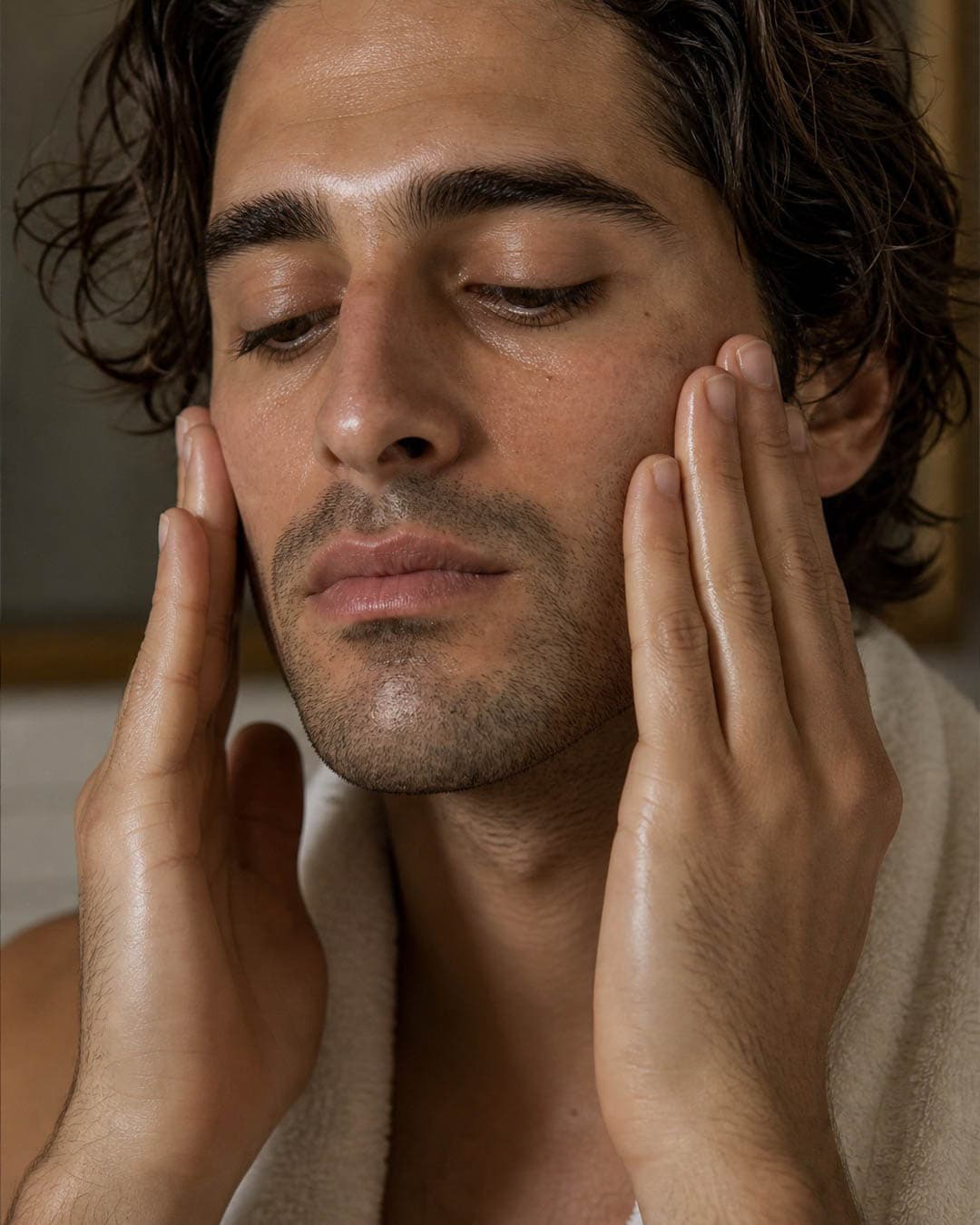
Why does skin feel different after moving to Germany?
The newcomers' forums say it better than we could. "I moved here last week and honestly the water and weather hit me hard," wrote one man on r/germany in September. Another, on r/EuroSkincare, named the suspects in one line: "Germany's hard water (Kalk), the cold, dry air, and indoor heating."
He is not wrong about the list. The water in much of Germany is measurably hard, and the air in a heated flat in January is measurably dry. Both are published by the people who supply them, so the rest of this page uses their numbers rather than anyone's impression.
What no utility publishes is what any of it does to your particular face. The honest position is that the water and the air both change, in the same winter you arrive, and the face is where you notice.
How hard is the water in Berlin, Munich and Hamburg?
Hardness is the calcium and magnesium dissolved in the water: the white crust on the kettle and the shower screen, which Germans call Kalk. It is measured in degrees of German hardness, °dH. The law that sets detergent doses sorts water into three bands: soft below 8.4 °dH, medium from 8.4 to 14, hard above 14.
| Where | Total hardness, °dH | Band |
|---|---|---|
| Berlin, Beelitzhof works | 17.0 | hard |
| Berlin, Friedrichshagen works | 20.3 | hard |
| Berlin, Kaulsdorf works | 20.0 | hard |
| Berlin, Kladow works | 18.4 | hard |
| Berlin, Spandau works | 15.1 | hard |
| Berlin, Stolpe works | 15.3 | hard |
| Berlin, Tegel works | 15.3 | hard |
| Berlin, Tiefwerder works | 22.4 | hard |
| Berlin, Wuhlheide works | 23.3 | hard |
| Munich, city supply | 15.8 | hard |
| Hamburg, lowest and highest values | 5.1 to 18.3 | mostly medium |
So every one of Berlin's nine waterworks delivered hard water last year, from 15.1 °dH at Spandau to 23.3 at Wuhlheide; which works fills your tap depends on your address. Munich's water is hard too, at 15.8. Hamburg is the exception of the three: its water is mostly in the medium band, though the values across its works run from soft to hard, and Hamburg Wasser prints the figure for your building on the water bill.
Some of what hardness does is plain chemistry. Calcium and magnesium react with soap to form an insoluble film, soap scum, which is why a bar of soap lathers grudgingly here and the tiles go grey. Most shower gels are synthetic detergents and do not form that scum. Whether any of this is what you feel on your face, no table can tell you.
Why is the air indoors so dry in winter?
Cold air holds little water. Bring it indoors and heat it to twenty degrees, and the same small amount of water is now spread through air that could hold far more, so the relative humidity falls. The heating does not remove water; it just makes the air thirstier.
The Umweltbundesamt, Germany's federal environment agency, advises keeping indoor humidity between 40 and 60 percent, and notes that a simple hygrometer is enough to keep an eye on it. One costs a few euros. "Once the heater's on in winter, the room feels like a desert," as someone put it on Reddit; the hygrometer turns the feeling into a number.
What helps when your face feels tight after the shower?
- Shorter, lukewarm showers. A long hot one feels wonderful while it runs; the face tends to feel tighter afterwards than after a quick warm one.
- Pat the face half-dry. Leave it damp, not bone-dry.
- Three to four drops of oil, warmed between the palms and pressed into the still-damp skin. An oil adds no water of its own; on damp skin it slows the water already there from leaving. The method, drop by drop, is in our guide to oil on damp skin.
- If your face wants more in winter, cream first and oil on top. Whether you need both is its own question: oil or cream.
- Read the hygrometer. If it sits well under 40 percent, a humidifier in the bedroom can bring the air up; clean it as its manual says, and keep the room under 60, where the Umweltbundesamt starts to worry about mould.
Airing deserves a note, because Germany takes it seriously. Stoßlüften, windows wide open for about five minutes two or three times a day in the cold months, is the Umweltbundesamt's advice against stale air and mould. In winter it lets in cold, dry air, so it will not make the room more humid; do it for the air, not for your face. The tilted window, gekippt all day, does neither job well and mostly heats the street.
Nothing on this list changes the water, and nothing in a bottle does either. What you can change is how long the water already on your face stays there.
If what you feel is more than tightness, or it does not settle, that is a question for a doctor (a Hausarzt, or a Hautarzt for skin) or the pharmacist at any Apotheke, not for a face oil. A cosmetic oil is not a treatment, and we make no promise about any skin condition.
What are the bottles called on a German shelf?
Half the problem is the label. "My Germans not good enough to tell if I'm buying the right thing" is a fair description of standing in a drugstore aisle at nine at night. The words that matter:
| On the label | What it means |
|---|---|
| Gesichtsöl | face oil |
| Gesichtscreme | face cream |
| Feuchtigkeitscreme | moisturiser (literally, moisture cream) |
| Tagescreme · Nachtcreme | day cream · night cream |
| für trockene Haut | for dry skin |
| rückfettend | with added oils or fats; common on shower gels and washes |
| Duschöl | shower oil |
| Harnstoff (Urea) | urea, a common ingredient in creams for dry skin |
| parfümfrei · ohne Duftstoffe | fragrance-free |
| Naturkosmetik | natural cosmetics: a shelf section and a label word |
| Jojobaöl | jojoba oil |
| Hagebuttenkernöl · Wildrosenöl | rosehip seed oil |
| Kalk | limescale, the hard-water deposit |
One shortcut: the ingredient list is printed in INCI, the international naming system, so it reads the same in Berlin as it did at home. Naturkosmetik on the front tells you which shelf it sits on; the INCI list on the back tells you what is in it.
Rosehip is where the names get slippery: Hagebuttenkernöl, Hagebuttenöl, Wildrosenöl and Rosenöl are not all the same thing, and one of them is not even pressed from a seed. We wrote out the names at dm and Rossmann, one by one.
Where do you buy skincare in Germany?
- Drogerien: dm, Rossmann and Müller. Creams from a couple of euros, their own ranges (Balea at dm, Isana at Rossmann), a Naturkosmetik section, and plain jojoba and rosehip oils on the shelf.
- The Apotheke: the pharmacy. Pharmacy skincare ranges, and a pharmacist you can ask, which matters if the question is more than skincare.
- Us, online only. The Moisturising Elixir is sold at docbankman.com and nowhere else: not at dm, Rossmann or Amazon.
The Moisturising Elixir is one face oil, 30 ml, €29.99: 82.5% jojoba oil, 15% rosehip seed oil, a 2% blend of five essential oils for the scent, and vitamin E. There is no water in it, Berlin's or anyone's, so there is no preservative system either. Doc Bankman is a character. The oil is real: mixed by hand by Jon Gore in Berlin.
It goes out by DHL within Germany within 2 working days, €3.67, free from €50, with 14 days to change your mind: the details are on shipping and delivery in Germany.
Questions
- Damp skin or dry skin?
- Damp. An oil adds no water of its own; pressed into damp skin, it slows the water already there from leaving. Why damp skin matters
- Instead of a moisturiser, or with one?
- Either. Alone it is the whole routine for many faces; if yours wants more in winter, cream first, oil on top. Face oil or moisturiser?
- Where can I buy it? Is it at dm?
- Only here, shipped within Germany. No shop shelf, no marketplace.
- Hagebuttenkernöl, Wildrosenöl, Rosenöl: what is the difference?
- Hagebuttenkernöl and Wildrosenöl are German names for oil pressed from wild-rose seeds; Rosenöl is an essential oil distilled from petals. Ours is Rosa Moschata Seed Oil, 15% of the bottle. Rosehip oil in German, name by name
Sources
- Berliner Wasserbetriebe, Analysendaten der Wasserwerke, Jahresmedianwerte 2025 (total hardness by waterworks)
- Stadtwerke München, Fragen und Antworten zu M-Wasser (total hardness 15.8 °dH, 2.8 mmol/l)
- Hamburg Wasser, Informationen über die Beschaffenheit des Trinkwassers (values from calendar year 2025)
- Hamburg Wasser, Mein Trinkwasser (hardness bands in °dH; mostly medium hardness)
- Wasch- und Reinigungsmittelgesetz, § 9 (the legal hardness bands)
- Umweltbundesamt, Wie lüfte ich richtig? (indoor humidity 40 to 60 percent, hygrometers, Stoßlüften)
- Umweltbundesamt, Richtig heizen, Schimmelbildung vermeiden (cold air holds less water)
- Wikipedia, Hard water (soap scum and lather)